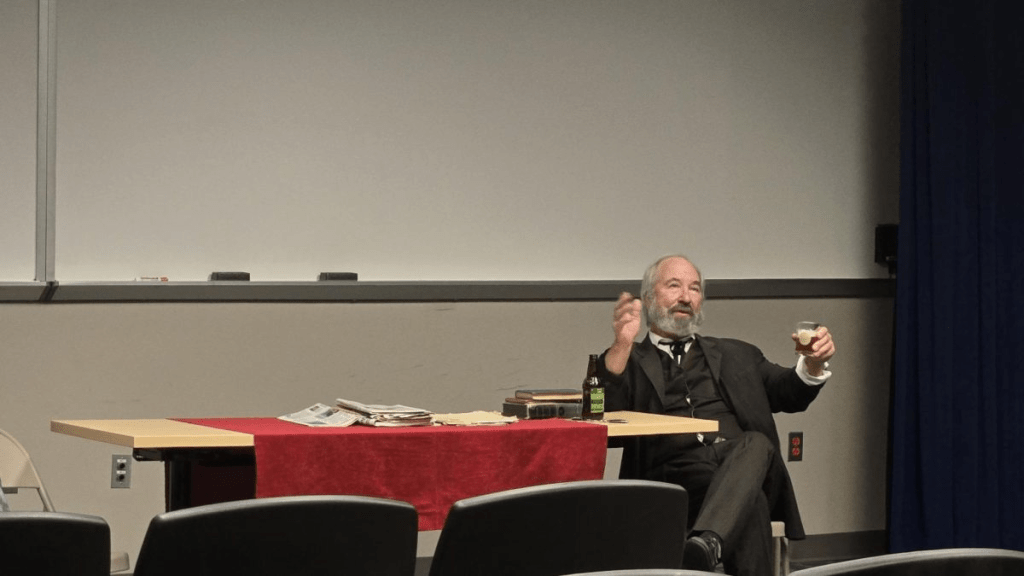
Karl Marx came to Rowan in “Marx in Soho” by historian Howard Zinn, a one-man play that revives Marx to confront modernity.
It occurred on Mar. 11 at 6:30 p.m. in King Auditorium, Bozorth Hall, and continued until about 8:00 p.m., premised on one question: If Karl Marx were raised from the dead, what would he say? The play served as a monologue against the sins of the modern world, in defense of Marx, and against Marxism’s various misinterpretations and abuses.
“As someone actively involved in the organizing space, a lot of the criticism that organizers get is like, ‘these ideas aren’t relevant anymore.’ I think that’s something we’re constantly trying to battle, so I think it helps to communicate why they’re still relevant,” said Yuval Saar, a senior sociology major.
It wove heavy systemic and social commentary with a love story between Marx and his wife. The antagonist — Mikhail Bakunin, a 19th-century rival anarchist revolutionary, and the ever-present elite of the past and present.
“The heart of the message is the humanizing elements about his personal life and his family, and his children. But there are those moments where I can bring out Elon Musk blowing up billion-dollar rockets or Zuckerberg,” said Bob Weick, the play’s actor.
“Marx in Soho” is not a new play, nor is Bob Weick new to it. It was written by Howard Zinn in 1999. Bob Weick picked up the role in 2004. Since then, he’s been touring the world and updating the script to adapt to the modern age. Despite its age, Weick referenced I.C.E., tariffs, Artificial Intelligence, Trump, and so on.
“Howard gave me permission to make adjustments to the play based on current events,” said Weick.
It was hosted by the Philosophy Club, Sociology and Anthropology Club, Rowan SJP, and Rowan Young Democratic Socialists of America. It had support from a coalition of various departments and student organizations, such as the Rowan Students for Justice in Palestine, Communication Studies, Political Science & Economics, Writing Arts, Theatre & Dance, and History. They managed to raise about $1150.
“We didn’t run into anything with the university. We have a lot of autonomy as student groups. It was just a lot of emails to a lot of different departments,” said Saar.
A Q&A session was held afterwards. While only about a third of the seats were filled, the reception was positive.
“I like it, I thought it was very necessary for the times,” said Dylan Adair, a sophomore accounting major.
For comments/questions about this story, DM us on Instagram @thewhitatrowan or email Mackay55@rowan.edu
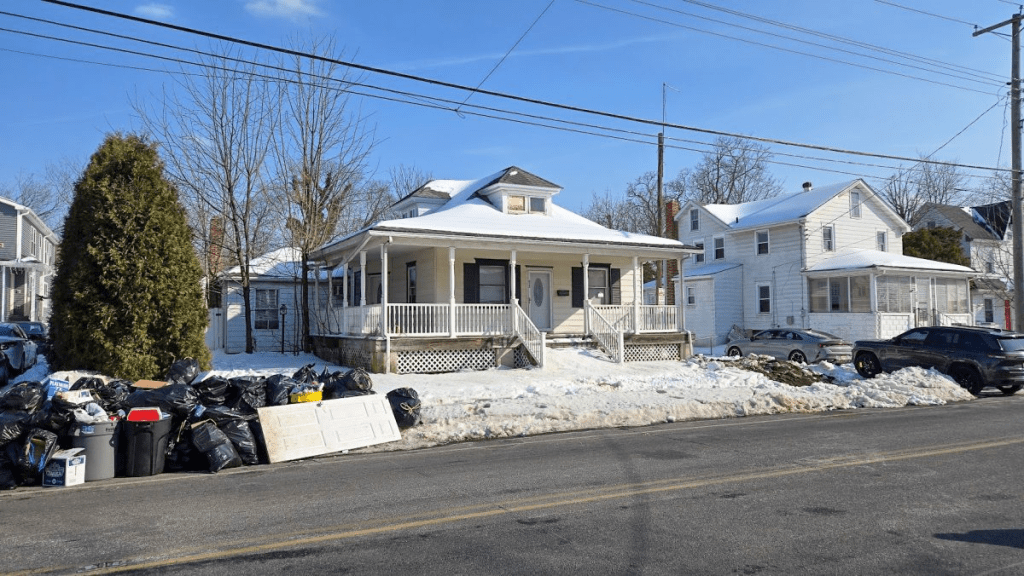
The current house on 312 N. Main St. Wednesday, Feb. 4, 2026. Glassboro, N.J. (Staff Writer / Aidan Vanhoof)
A home by Rowan University is to be demolished and replaced with new student rental housing.
The Glassboro Planning Board unanimously approved the demolition of a home located at 312. N. Main St. to be replaced with a nine-bedroom, four-bathroom rental property, in a Jan. 6 meeting, according to real estate developer Elizabeth Quam.
The property is zoned for residential housing, specializing in student use. It will include parking for about 10 vehicles and a private driveway, in addition to dedicated recreation and basement spaces. In total, it will span approximately 4,200 square feet, not including the porch or second-story balcony.
“They came before the board, did a very good job, and the board approved it,” said Clarke Pierpont, zoning officer for the Glassboro Planning Board.
The number of tenants will likely match the number of bedrooms, due to lease agreement restrictions and a broad but newfound preference for singles, according to the Courier Post.
A blueprint of the future home that will replace the current one on 312 N. Main St. (Elizabeth Quam)
Rowan Boulevard brought a shift away from doubles, as apartments lining the boulevard were constructed, for the most part, as singles. Generally, students now seek greater privacy, unlike in Rowan’s past. As a result, it’s highly unlikely the new property will reach anywhere close to legal capacity, according to Quam.
The location was chosen for its proximity to Rowan and Glassboro’s downtown area.
“The majority of my tenants are Rowan students,” said Quam. “What I try to do is have places that are conveniently located to, not only the school itself, but some of the stores and places students often walk to. North Main has been a very nice location for others. And this property is right between two other properties I own.”
Despite its proximity to Rowan, there was very little comment from University Housing officials regarding the project.
“The project at 312 N. Main Street is not something that University Housing is involved in,” said Barry Hendler, the assistant dean of residential learning and university housing.
Quam, who once upon a time was a Rowan student herself, does not plan on developing further student housing.
“We do have a couple more renovation projects,” said Quam. “But the new ordinance that they passed in this past year has upped the cost greatly to where, financially, I don’t think it makes sense to be able to do what we’ve been able to do in the past.”
These regulations, which regulate parking, landscaping, and home design, are in place to ensure houses can adequately facilitate residents.
“The main design controls are there to ensure there’s adequate parking, landscaping, and things like that for the home so that it’s not an inconvenience for the neighbors or the residents who end up living there,” said Pierpont.
For comments/questions about this story, DM us on Instagram @thewhitatrowan or email ottoch32@rowan.eduView Story CommentsLike This Story
I would like to cover Vineland’s reaction to new A.I. data centers. Recently, there has been bipartisan outcry against new data centers among Vineland locals, culminating in a council meeting that lasted several hours. However, despite public opposition, the data center was pushed through. I would like to explore how the community has reacted to this change, and if this has affected their trust in local representatives.
“You know, I’ve seen people turn into kids again.”
In 2015, Dan McDevitt, a Deptford High School graduate, decided to post his party’s invitation to Facebook, not realizing it meant over 123 people would show up. This party, a reunion of old high school friends, took inspiration from local Catholic schools’ high school reunions, wherein long-lost friends reunited, and new lifelong friends could be created.
Deptford High School, to some degree, has had some. But, to McDevitt, constrained by regulations, they lacked soul. They lacked the frenzied energy McDevitt’s teenhood “keggers” exuded. And they lacked precisely the energy McDevitt sought to replicate.
“I said, well, after 2 years, ‘what are the rules?’ Everyone’s like, ‘you don’t want to do that,’” McDevitt said, angling his hands parallel to depict an endless list. “If I were to do the official school event as the board of education says, they’d be like, ‘here’s your rules and stuff you can’t do.’”
Early on, McDevitt gained experience hosting parties. Growing up in the 1970s, friends and neighbors dubbed him the “king” of house parties; his home, a social hub for neighborhood kids and adults alike. Later, he helped host concerts, revealing a talent for crowd control.
“As a child, I was the king… my brother had him and his friends come. My sister had all of her friends go. And then I got mine. It was a different time. The whole neighborhood showed up,” McDevitt said.
Following graduation, rifts between friends widened. Keeping up while maintaining jobs, families, relationships, etc., demanded an explicit reason to do so. Such a party seemed like a perfect solution.
The idea emerged in the early 90s, but it took another 20 years to realize. It all started in 2015, prompting an ongoing and ever-expanding tradition.
Now, he holds them yearly, wielding a small team of organizers and drawing dozens of attendees.
“Every year has its own little, ‘did that happen? Did they get married?’” McDevitt said. “They start all quiet. Two years later, they’re out dancing. A whole social life started with that event.”
The next event will be held on October 3rd, 2026 at 4 p.m. at Spartans at the Elks.
The inside of the Glassboro Municipal Building. Tuesday, March 25, 2025. Glassboro, N.J. (News & Photography Editor / Christopher Otto)
Glassboro residents expressed fears for road and pedestrian safety amid icy conditions at the most recent borough council meeting.
The meeting, held on Feb. 10, 2026, at the Glassboro Municipal Building, began with Mayor John E. Wallace III presenting Lieutenant Charles Williams of the Glassboro Police Department and record-keeper Melissa Rovin with Years of Service Awards. Williams had 25 years of service under his belt, while Rovin had 36.
“Those are two impressive careers. You both will be sorely missed, and again, thank you both for your dedication to our residents of the fine borough of Glassboro,” Wallace said.
Following the mayor’s presentation, the council held a public hearing to approve a new stormwater management agreement from Atlantic City Electric Company, which passed without comment. The council then approved a series of resolutions, including the authorization of the release of a safety and stabilization guarantee of $23,680.02 for QC South Storage as well as a performance guarantee of $63,435 upon the posting of a required maintenance bond, the authorization of the release of administrative fees for Loud Wellness, LLC under the recommendation of borough Chief Financial Officer (CFO) Karyn Paccione, and the authorization of the execution of post-construction compliance forms for solar projects located on landfills and contaminated sites.
The council then introduced Ordinance 26-05, which authorized a 20-foot easement for Glassboro resident John R. Defronzo. A public hearing is to be held at the next council meeting on Feb. 24. The council also tabled Ordinance 26-06, which amends existing rules to remove residency requirements for the Administrator Position.
Following these approvals, council members thanked city employees, emphasizing their snow removal efforts.
“Obviously, the storm is pretty unprecedented in the last 20 to 30 years,” said Democratic councilman Andrew Halter. “We haven’t really seen anything like it, especially with the ice and impact. But they continue daily to clear up intersections and crosswalks and things like that, evidenced by their new emerging mountain. Thanks to all the work of all the employees around because of what they’re doing to keep our borough open.”
The public portion of the council meeting then began, where Glassboro resident Cherie Bishop-Sinor discussed snow removal with the council. In an area with heavy pedestrian traffic, uncleared sidewalks pose a significant danger —especially to students. Bishop-Sinor proposed greater ordinance enforcement and reform as a solution.
“I think it’s time for some new ordinances,” Bishop-Sinor said. “You know this was an odd storm to get, but it shed a light on issues, so there’s a responsibility of this borough to make sure that the children who are walking to school to and from are safe.”
Bishop-Sinor then expressed concerns for driver safety, citing running red lights and past accidents at the intersection of Delsea Drive and Donald Barger Blvd as evidence. She offered an increase in dedicated left-turn signals, enhanced enforcement, and new control measures like cameras, as potential solutions.
“Problem intersections are being addressed by the county and the state,” Wallace said.
Another speaker, Sean Feeny, a Glassboro resident, also cited minimal snow removal efforts beyond main roads.
“Areas that need access to sidewalks or are dirt trails or anywhere in between, a lot of those have been overlooked, especially in regard to private land,” Feeny said. “I think that I should call on our ordinance people to increase accountability for not just the tenants, but also the landowners.”
The mayor stated Glassboro is doing the best it can, as it cannot encroach on state or county roads, meaning some may remain unplowed.
Then, Lynda Gallashaw, a Glassboro resident claiming to represent the Glassboro Civic and Cultural League, cited multiple concerns: Glassboro’s recognition of Black History Month, a park bathroom construction project at Elsmere Park, which is located at 275 Higgins Drive, budget and tax concerns, and new marijuana dispensaries opening.
“Could you enlighten me on what the council or the borough has planned for Black History Month?” Gallashaw said. “We’re now on day 10, and I have not seen anything posted that the borough’s doing for Black History Month.”
Wallace cited educational programs, council members’ personal celebrations, and the borough’s official recognition of Black History Month in response.
Additionally, a bathroom to be installed at Elsmere Park will be made of wood, even though, according to Gallashaw, brick has both greater durability and cost-efficiency. She has brought this issue to the council twice before. Despite this, the mayor stated they are “moving ahead in full.” Finally, she complained of increasing taxes. Wallace stated that while taxes were increased to rebuild surplus, any increases would have been by cents.
Gallashaw also found the high concentration of fast-food and marijuana dispensaries concerning. The council cited a legal limit of two dispensaries and a lack of interest in sit-down restaurants in response.
“To say we’re full of fast food and marijuana, I’m going to have to disagree,” Wallace said.
The public portion ended at 7:42 p.m., and the council wrapped up the meeting with their closing remarks.
“We want to encourage you, please come out and entice everybody to come here tonight,” Wallace said. “I encourage you to come out and stay involved. To those of you that came up here and spoke this evening, thank you. Please continue to do so.”
For comments/questions about this story, DM us on Instagram @thewhitatrowan or email ottoch32@rowan.edu
On Saturday, Alex Pretti, a 37-year-old intensive care unit (I.C.U.) nurse, crossed the street to film Border Patrol agents confronting peaceful protestors in Minneapolis, Minn.
Roughly ten agents were present. An officer spotted Pretti – who was holding nothing but a phone – shoved him, and sprayed chemicals in his face, bringing him to his knees. Seconds later, he was pinned to the ground with six new agents piled atop him. One agent grabbed a holstered gun from Pretti and ran across the street. Shots rang out.
Pretti was shot ten times and killed. He was searched seconds after. He was not provided medical assistance by federal agents until minutes after the shooting. That same day, Department of Homeland Security (D.H.S.), declared the border patrol agents the true victims, claiming Pretti tried to do “maximum damage and massacre law enforcement.” They used the gun taken from Pretti’s holster as proof. Video evidence contradicts this narrative.
This comes just weeks following the shooting of Renee Good, a 37-year-old single mother, on Jan. 7. She, too, was labelled a domestic terrorist. Her death has since been deemed a homicide, according to Fox 9.
The killings of Good and Pretti, paired with preexisting tensions over Operation Metro Surge, an ongoing Immigration and Customs Enforcement (I.C.E.) operation in Minnesota, have spurred mass movements compared to those following George Floyd’s death in 2020. Worse, despite recent media attention, they aren’t alone. In 2025, another 32 people died in I.C.E. custody and hundreds more disappeared, according to The Guardian. Recently leaked D.H.S. documents appear to permit federal officers to enter homes without warrants.
All of these indicate a pattern of authoritarian behavior. Videos depicting I.C.E. and Border Patrol firing unprovoked on protestors, reports of missing detainees, and documents condoning entry into private homes without warrants all mirror a continued disregard for the Constitution and basic human rights.
Sure, protestors interrupted federal law enforcement. But so long as they weren’t actively threatening, they were allowed to be there, per their First Amendment rights. Sure, immigrants should come here legally. But holes in the immigration system – like economic barriers, legal representation issues, and limited pathways to citizenship – ensure that’s impossible for many.
That’s not to mention over 1.6 million had preexisting legal status slashed by the Trump administration, according to NPR. Sometimes it’s easy to think undocumented immigrants are the only victims. That if you’re here legally, you’re safe. But, according to ProPublica, I.C.E. continues detaining and even killing legal U.S. citizens. People have been detained and immediately deported without due process. Or to countries they’ve never been to before, meaning we can’t hide behind legal status anymore.
The current reality is a bleak one, and it can be tempting to run from it. But this issue is local. People are scared. At least, I’m scared. I.C.E. has been all across New Jersey, including my hometown of Deptford. Last semester, false reports on Instagram said I.C.E. had even made it to Rowan.
However, to flee reality not only endangers immigrants, but also often one’s whole community. Awareness may be difficult, but it’s necessary during times like these. Most support for immigrants over the past year has come from citizen organizations and churches, not large organizations, particularly in low-income areas.
Federal agents conceal their faces, and bodycam use is minimal. While D.H.S. Secretary Kristi Noem claims investigations have been done, investigators, including those from the F.B.I., are kept from the evidence and pressured to cease, according to The Guardian.
Internal accountability measures are evidently limited, so citizen organizations have attempted to fill the void. For example, icelist.is: a public list of identified I.C.E. agents with names, faces, and any other findable information created by Crust News, a Substack-based news organization.
Combatting I.C.E. is therefore a practice in solidarity and community awareness, making complacency, i.e., covering your ears until it all goes away, unethical. Neutrality enables the Trump administration to continue unobstructed.
This isn’t to say political centrism is necessarily the problem, or that my particular political leanings are the only solution. This isn’t to say that if news like this affects your mental health, you shouldn’t step away. And this isn’t to say we should all go out and fight federal agents in the streets or protest nonstop.
But this is to say, actively ignoring what’s happening has a very similar effect to actively supporting it
The Trump administration lies regularly. Seeing through the lies alone constitutes a powerful form of resistance. While it may not equate to actually taking action, authoritarians rely hugely on ignorance to gain, centralize, and maintain power. That includes not only Trump himself but those working for him.
However, above all else, stay safe and know your rights. Federal agents cannot enter your home without a warrant signed by a judge. You do not have to speak to them. You do not have to sign anything they give you. And you can film and photograph them in all public spaces.
Resisting brutality doesn’t just mean fighting and harassing federal agents. It can mean simply reading the news and forming an informed opinion. It just needs to happen, and it isn’t happening enough.
The cogeneration power plant, located behind Discovery Hall. Wednesday, Jan. 28, 2026. Glassboro, N.J. (Staff Writer / Aidan Vanhoof)
The cogeneration power plant located by Discovery Hall malfunctioned, causing a mild reduction in temperature across the campus.
According to a Rowan Advisory email sent out to all Rowan students and faculty on Friday, Jan. 16, buildings across the campus were about 5 degrees cooler.
“Last night the Co-Gen Power Plant on the Glassboro Campus malfunctioned, reducing the steam capacity needed to heat the campus,” the email said. “Repairs are expected to be completed this afternoon. Until then, most buildings will be 5 degrees cooler today. Please dress appropriately. Thank you for your patience.”
Repairs were delayed until the following day, as an essential component failed before its scheduled replacement date, forcing the power plant to operate at 50% power. Contractors repaired it until a sensor failure caused other components to shut down.
Replacements were found, and the power plant returned to normal functioning the same afternoon.
“The simple explanation is that a component failed before its scheduled replacement date, which forced the co-gen plant to operate at 50 percent capacity,” said Joe Cardona, the vice chancellor for University Communication. “Contractors made the necessary repairs, but then small sensors failed, forcing some systems to shut down. Once the faulty sensors were identified and replaced, the co-gen returned to normal operations.”
Some students, like freshman music industry major Brandon Lattanzi, did not seem to have noticed any substantial difference in temperature.
“My Chestnut dorm has not had heat for this whole winter, so I wouldn’t have known,” said Lattanzi.
One student, Tory Lobby, a freshman radio, television, and film major, noticed a slight difference.
“I want to say slightly, but it wasn’t that big of a deal. I did study in my friend’s dorm, which was in Chestnut, and that was much colder. It was freezing in there,” Lobby said.
Students consistently complained of low temperatures across campus, especially in the dorms. Some dorm buildings, such as Chestnut, lack reliable heating to begin with, meaning the 5-degree cooling hardly made a difference, according to Lattanzi and Lobby.
Co-generation power plants produce power by fusing geothermal and electrical power. A division of Caterpillar Corp. manufactured it for a 2007 installation to improve reliability, efficiency, and environmental friendliness, according to a Rowan Today article on the topic.
The co-gen power plant contributes to a broader campus-wide initiative started in 2009, called the Carbon Neutrality Action Plan, designed to enhance environmental sustainability.
According to the Carbon Neutrality Action Plan, Rowan hopes to have geothermal energy heat the whole campus by 2029. This comes just prior to a historic blizzard on Jan. 25 that caused over a million people to lose power and killed 62 people, according to USA Today.
For comments/questions about this story, DM us on Instagram @thewhitatrowan or email ottoch32@rowan.edu
Former Gloucester County Administrator Chad Bruner. (sites.rowan.edu)
Following over 32 years spent working for the county, Chad Bruner, chair of Rowan’s Board of Trustees, has retired as county administrator for Gloucester County, effective Dec. 1.
Recent gubernatorial candidate and former Senate president Steve Sweeney, who was sworn in as a member of Rowan’s Board of Trustees this semester, will fill Bruner’s seat.
“I retired because I have worked over 32 years at the county, and my family relocated to Florida over 3 years ago, and it was time for me to join them, as my daughter will be getting married in March and my son will be graduating from Florida Gulf Coast University,” said Bruner.
Initially, he was to be replaced by deputy county administrator and close associate of Sweeney, Michelle Coryell. However, she may be charged with theft after allegedly stealing documents from a Republican county commissioner on June 11, according to the New Jersey Globe.
This and a communication error sparked some controversy among county politicians. Republican county commissioner Chris Konawel claimed in a Facebook video that he and Nicholas DiSilvio, another Republican commissioner, were not informed of Bruner’s retirement until the evening of Dec. 2.
“Scuttlebutt about Mr. Bruner’s retirement had been ongoing for months. We heard from people working in various departments he would be retiring at the end of summer, then it was after the next election, then it was end of year,” said DiSilvio. “We heard from friendlies in various departments that he had officially retired, beginning the workday on December 1, the chatter continued on December 2.”
Konawel speculated administrators deliberately failed to notify him and DiSilvio partly to conceal “ongoing criminal investigations.”
“Everybody’s heard it was coming, everybody’s heard the news, multiple people in the county were notified. But the sitting county commissioners, myself and Nick DiSilvio, have not heard one word about this,” said Konawel. “Certain people clearly don’t want that information coming to light. When an administrator resigns suddenly without formal notice, while someone with possible criminal exposure steps into control, and commissioners are deliberately bypassed, something is very, very wrong.”
The Republican commissioners asked to be consulted when finding a new county administrator, but they were not, according to an aide to DiSilvio.
However, Coryell first landed the candidacy for administrator per the “County Administrative Code and Rules”, according to Eric Campo, county counsel for Gloucester County.
Additionally, Bruner, a Democrat, applied for retirement “many months ago” via the state retirement system and received an official retirement date of Dec. 1, according to Campo. This follows a significant blow to the Republican party during last month’s election, which maintained Democratic control over the county government.
At the time of writing, Bruner intends to stay on Rowan’s Board of Trustees, as his term doesn’t expire until June 30, 2029.
For comments/questions about this story, DM us on Instagram @thewhitatrowan or email ottoch32@rowan.edu
The Apollo lunar lander sits outside of the entrance to Science Hall. Tuesday, Nov. 11, 2025. Glassboro, N.J. (Staff Writer / Aidan Vanhoof)
A miniature model of an Apollo lunar lander has officially been put on display outside the Edelman Planetarium, located at Science Hall, after months of restoration.
Having arrived at Rowan on Oct. 21, the model was brought to the university with the goal of permanently helping educators immerse visitors in stories of spaceflight. Rowan purchased the one-third scale model in 2024 from NASA’s Artifact Program, a program helping eligible non-profits obtain NASA artifacts for educational use, when, for years prior, it spent its life in a state of disrepair at the Marshall Space Flight Center in Huntsville, Alabama.
“Combined with Luna, our Artemis Moon Tree, the lander will help us to tell the story of human spaceflight, past and present, and help us to answer the questions ‘Where do we come from,’” said Amy Barraclough, the director of the Edelman Planetarium.
Once Rowan acquired it, restoration began in May 2025 by StoneDog Studios, a woman-owned design and fabrication company based in Freehold, N.J. It took five months to complete, according to the Edelman Planetarium’s website, as the Planetarium aimed to have the model durable enough to be displayed outdoors.
“There were a few bits missing, so we needed to fabricate them from scratch. For example, there were many small gray thrusters missing, so fabricator Katie Walsh created a custom mold and cast new ones out of resin,” said Kate Eggleston, a mixed media fiber artist working for StoneDog Studios.
Upon arrival at StoneDog, its parts were scattered across three crates. It needed a functioning support structure, thrusters, as well as various aesthetic fixes for degraded or dated parts.
“Overall, we all worked on the lander at some point over the course of a few months. In total, nine people assisted in the restoration project,” said Eggleston. “We are all very proud of the final outcome.”
The refurbished model was transported to Rowan in two separate crates. When fully assembled, it weighed approximately 800 pounds, meaning installation efforts took nine people — including workers from StoneDog, movers, carpenters, and groundskeepers—several hours to complete.
It was funded by alumni Ric and Jean Edelman, the planetarium’s namesakes, costing nearly $20,000 in shipping and refurbishment costs. According to Barraclough, the model itself costs nothing.
Many students didn’t seem to notice or question that there was anything new outside of the Planetarium, though the model did still garner some curiosity and interest.
“I think it’s pretty cool, and since it’s from NASA, that makes it a lot neater,” said Jared Wilkins, a senior exercise science major.
For comments/questions about this story, DM us on Instagram @thewhitatrowan or email ottoch32@rowan.edu
Friedrich Nietzsche, 2004, by Enrique Carceller Alcón
I do not speak of that greatness which is achieved by the fortunate politician or the successful soldier; that is a quality which belongs to the place he occupies rather than to the man; and a change of circumstance reduces it to very discreet proportions. The Prime Minister out of office is seen, too often, to have been but a pompous rhetorician, and the General without an army is but the tame hero of a market town.
–W. Somerset Maugham, The Moon and Sixpence, 1919
Stoic philosophy lately has seen a resurgence, though perhaps not the kind we’d want. While it’s been rising, enticing more and more to the joys of philosophy, it’s also been dumbed down to such an extent that it’s lost much of its meaning. However, it still has value, and ideally the desperate “alpha-males” brought to philosophy may actually gain an appreciation for it.
I write mostly about critical theory, but Stoic and existentialist literature interests me a lot. Aurelius and Camus provide magnificent guidance for modern life, despite both having died 2000 and 60 years ago, respectively. Their magnum opuses, Camus’ The Myth of Sisyphus and Aurelius’ Meditations, offer guidance on facing an absurd, meaningless, and frankly terrifying existence.
The most common advice? Express yourself–the same advice you’ve probably heard a million times.
I don’t mean to parrot the most basic possible advice given to just about every person on the planet. It’s certainly a bit irritating to hear over and over again, without any clarification, specificity, or, ironically, authenticity, that I should be authentic. It’s a nicety, a piece of advice given like party favors to each person, most of whom have heard it so often it’s been blunted and lost all meaning.
However, what Maugham wrote has a lot of meaning. It implies that authenticity comes in the social recognition of oneself, not one’s outermost layers.
Among my favorite thinkers, psychoanalyst Jacques Lacan, essentially dismantled the “be yourself” mantra. Each of us, deep down, has a version of ourselves we feel is our best, most authentic, most honest self. This ideal, what he called the Ideal-I, is socially constructed according to who we think others want us to be. To achieve it, we don’t work towards it. We project it, attempting to embody it and persuade other people through clothes, jewelry, new manners of speaking, and so on; paradoxically believing that, by projecting it, we are working towards it.
This Ideal-I, which structures desire itself, is fundamental to our identity.
The most discomforting implication of this is, of course, that we can’t be authentic. Our most honest identity, shed of each veneer and projection, is in fact a veneer and projection itself. We are, at all times, fake.
However, it’s not all miserable. Identity being socially constructed means identity is principally social, not individualistic. It comes from expressing oneself to a group, yes. But that means one must find a group they can express themselves to, i.e., they must find a group they fit best into. Through this, one can find true authenticity.
And in the end, the best way to hunt such genuine bonds is by expressing oneself to the world, outwardly and unveiled. Essentially, creatively.
It isn’t just through the ups and downs of love, platonic or romantic. Nor is it through Nietzsche, a 20th-century philosopher with an admiration for the powerful. His ideal is isolating and suppressive in itself. His diagnosis for nihilism (in part, the decline of higher meaning via a high power) is accurate; his solution for nihilism, achieving individual greatness, is deeply nihilistic.
It’s by finding solidarity among others, whether it’s joining an organization or a club, or involving oneself with family or groups of friends. It’s solidarity, belonging, and, ironically, bathing in what is essentially a gathering of ‘you’s’.
One’s ‘most authentic self’ is mostly nonexistent. Those who flee from society have a habit of losing their minds. Those who change society do so riding a wave made of many. Those who embrace society find themselves by finding others, so long as those ‘others’ are found without disguise and without pretense, while minimizing the inevitable but very human obsession with approval.
We become what we are immersed in. Thus, people among whom we can laugh freely, love deeply, and embody our most unobstructed selves are the most perfect mirrors. They are infinitely valuable.