Former Gloucester County Administrator Chad Bruner. (sites.rowan.edu)
Following over 32 years spent working for the county, Chad Bruner, chair of Rowan’s Board of Trustees, has retired as county administrator for Gloucester County, effective Dec. 1.
Recent gubernatorial candidate and former Senate president Steve Sweeney, who was sworn in as a member of Rowan’s Board of Trustees this semester, will fill Bruner’s seat.
“I retired because I have worked over 32 years at the county, and my family relocated to Florida over 3 years ago, and it was time for me to join them, as my daughter will be getting married in March and my son will be graduating from Florida Gulf Coast University,” said Bruner.
Initially, he was to be replaced by deputy county administrator and close associate of Sweeney, Michelle Coryell. However, she may be charged with theft after allegedly stealing documents from a Republican county commissioner on June 11, according to the New Jersey Globe.
This and a communication error sparked some controversy among county politicians. Republican county commissioner Chris Konawel claimed in a Facebook video that he and Nicholas DiSilvio, another Republican commissioner, were not informed of Bruner’s retirement until the evening of Dec. 2.
“Scuttlebutt about Mr. Bruner’s retirement had been ongoing for months. We heard from people working in various departments he would be retiring at the end of summer, then it was after the next election, then it was end of year,” said DiSilvio. “We heard from friendlies in various departments that he had officially retired, beginning the workday on December 1, the chatter continued on December 2.”
Konawel speculated administrators deliberately failed to notify him and DiSilvio partly to conceal “ongoing criminal investigations.”
“Everybody’s heard it was coming, everybody’s heard the news, multiple people in the county were notified. But the sitting county commissioners, myself and Nick DiSilvio, have not heard one word about this,” said Konawel. “Certain people clearly don’t want that information coming to light. When an administrator resigns suddenly without formal notice, while someone with possible criminal exposure steps into control, and commissioners are deliberately bypassed, something is very, very wrong.”
The Republican commissioners asked to be consulted when finding a new county administrator, but they were not, according to an aide to DiSilvio.
However, Coryell first landed the candidacy for administrator per the “County Administrative Code and Rules”, according to Eric Campo, county counsel for Gloucester County.
Additionally, Bruner, a Democrat, applied for retirement “many months ago” via the state retirement system and received an official retirement date of Dec. 1, according to Campo. This follows a significant blow to the Republican party during last month’s election, which maintained Democratic control over the county government.
At the time of writing, Bruner intends to stay on Rowan’s Board of Trustees, as his term doesn’t expire until June 30, 2029.
For comments/questions about this story, DM us on Instagram @thewhitatrowan or email ottoch32@rowan.edu
The Apollo lunar lander sits outside of the entrance to Science Hall. Tuesday, Nov. 11, 2025. Glassboro, N.J. (Staff Writer / Aidan Vanhoof)
A miniature model of an Apollo lunar lander has officially been put on display outside the Edelman Planetarium, located at Science Hall, after months of restoration.
Having arrived at Rowan on Oct. 21, the model was brought to the university with the goal of permanently helping educators immerse visitors in stories of spaceflight. Rowan purchased the one-third scale model in 2024 from NASA’s Artifact Program, a program helping eligible non-profits obtain NASA artifacts for educational use, when, for years prior, it spent its life in a state of disrepair at the Marshall Space Flight Center in Huntsville, Alabama.
“Combined with Luna, our Artemis Moon Tree, the lander will help us to tell the story of human spaceflight, past and present, and help us to answer the questions ‘Where do we come from,’” said Amy Barraclough, the director of the Edelman Planetarium.
Once Rowan acquired it, restoration began in May 2025 by StoneDog Studios, a woman-owned design and fabrication company based in Freehold, N.J. It took five months to complete, according to the Edelman Planetarium’s website, as the Planetarium aimed to have the model durable enough to be displayed outdoors.
“There were a few bits missing, so we needed to fabricate them from scratch. For example, there were many small gray thrusters missing, so fabricator Katie Walsh created a custom mold and cast new ones out of resin,” said Kate Eggleston, a mixed media fiber artist working for StoneDog Studios.
Upon arrival at StoneDog, its parts were scattered across three crates. It needed a functioning support structure, thrusters, as well as various aesthetic fixes for degraded or dated parts.
“Overall, we all worked on the lander at some point over the course of a few months. In total, nine people assisted in the restoration project,” said Eggleston. “We are all very proud of the final outcome.”
The refurbished model was transported to Rowan in two separate crates. When fully assembled, it weighed approximately 800 pounds, meaning installation efforts took nine people — including workers from StoneDog, movers, carpenters, and groundskeepers—several hours to complete.
It was funded by alumni Ric and Jean Edelman, the planetarium’s namesakes, costing nearly $20,000 in shipping and refurbishment costs. According to Barraclough, the model itself costs nothing.
Many students didn’t seem to notice or question that there was anything new outside of the Planetarium, though the model did still garner some curiosity and interest.
“I think it’s pretty cool, and since it’s from NASA, that makes it a lot neater,” said Jared Wilkins, a senior exercise science major.
For comments/questions about this story, DM us on Instagram @thewhitatrowan or email ottoch32@rowan.edu
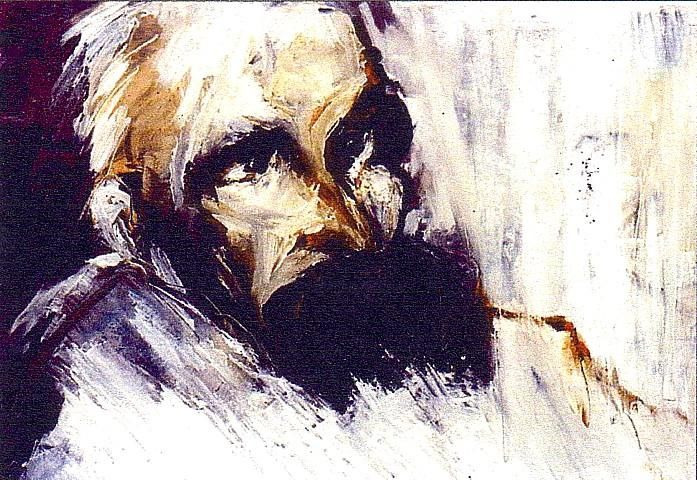
Friedrich Nietzsche, 2004, by Enrique Carceller Alcón
I do not speak of that greatness which is achieved by the fortunate politician or the successful soldier; that is a quality which belongs to the place he occupies rather than to the man; and a change of circumstance reduces it to very discreet proportions. The Prime Minister out of office is seen, too often, to have been but a pompous rhetorician, and the General without an army is but the tame hero of a market town.
–W. Somerset Maugham, The Moon and Sixpence, 1919
Stoic philosophy lately has seen a resurgence, though perhaps not the kind we’d want. While it’s been rising, enticing more and more to the joys of philosophy, it’s also been dumbed down to such an extent that it’s lost much of its meaning. However, it still has value, and ideally the desperate “alpha-males” brought to philosophy may actually gain an appreciation for it.
I write mostly about critical theory, but Stoic and existentialist literature interests me a lot. Aurelius and Camus provide magnificent guidance for modern life, despite both having died 2000 and 60 years ago, respectively. Their magnum opuses, Camus’ The Myth of Sisyphus and Aurelius’ Meditations, offer guidance on facing an absurd, meaningless, and frankly terrifying existence.
The most common advice? Express yourself–the same advice you’ve probably heard a million times.
I don’t mean to parrot the most basic possible advice given to just about every person on the planet. It’s certainly a bit irritating to hear over and over again, without any clarification, specificity, or, ironically, authenticity, that I should be authentic. It’s a nicety, a piece of advice given like party favors to each person, most of whom have heard it so often it’s been blunted and lost all meaning.
However, what Maugham wrote has a lot of meaning. It implies that authenticity comes in the social recognition of oneself, not one’s outermost layers.
Among my favorite thinkers, psychoanalyst Jacques Lacan, essentially dismantled the “be yourself” mantra. Each of us, deep down, has a version of ourselves we feel is our best, most authentic, most honest self. This ideal, what he called the Ideal-I, is socially constructed according to who we think others want us to be. To achieve it, we don’t work towards it. We project it, attempting to embody it and persuade other people through clothes, jewelry, new manners of speaking, and so on; paradoxically believing that, by projecting it, we are working towards it.
This Ideal-I, which structures desire itself, is fundamental to our identity.
The most discomforting implication of this is, of course, that we can’t be authentic. Our most honest identity, shed of each veneer and projection, is in fact a veneer and projection itself. We are, at all times, fake.
However, it’s not all miserable. Identity being socially constructed means identity is principally social, not individualistic. It comes from expressing oneself to a group, yes. But that means one must find a group they can express themselves to, i.e., they must find a group they fit best into. Through this, one can find true authenticity.
And in the end, the best way to hunt such genuine bonds is by expressing oneself to the world, outwardly and unveiled. Essentially, creatively.
It isn’t just through the ups and downs of love, platonic or romantic. Nor is it through Nietzsche, a 20th-century philosopher with an admiration for the powerful. His ideal is isolating and suppressive in itself. His diagnosis for nihilism (in part, the decline of higher meaning via a high power) is accurate; his solution for nihilism, achieving individual greatness, is deeply nihilistic.
It’s by finding solidarity among others, whether it’s joining an organization or a club, or involving oneself with family or groups of friends. It’s solidarity, belonging, and, ironically, bathing in what is essentially a gathering of ‘you’s’.
One’s ‘most authentic self’ is mostly nonexistent. Those who flee from society have a habit of losing their minds. Those who change society do so riding a wave made of many. Those who embrace society find themselves by finding others, so long as those ‘others’ are found without disguise and without pretense, while minimizing the inevitable but very human obsession with approval.
We become what we are immersed in. Thus, people among whom we can laugh freely, love deeply, and embody our most unobstructed selves are the most perfect mirrors. They are infinitely valuable.
I live a pretty comfortable life, all things considered. My nights are spent cozy, my days are spent at a school I’m privileged enough to afford. However, even in my plucky middle class position, I’m anxious about the future and our political situation. So I can’t imagine how genuinely gross this all must be to the transgender or Hispanic communities, for example, who are genuinely suffering. Or the millions worldwide subject to the effects of climate change, effects I only feel while sunburnt during hot summer days.
We need to be grateful. My life is good, but my life isn’t universal. Sometimes it’s easy to forget and lose empathy. But to forget is to grow complacent. As members of a society, we’re obligated to contribute to it; therefore, we have an obligation to work towards its betterment.
I’m not normally one to moralize a ton. Honestly, I don’t think it gets us very far. As an approach, it’s not oriented towards solutions, nor deep analysis: all it looks like is complaining. But solidarity can’t be dumped away. We have to cling to it at all times, even just as a basic principle.
Sometimes, when I’m feeling good, I try really hard not to think about what billionaire property developer Zygmunt Wilf’s trying to do with the Second Watchung Mountain Ridge forest in West Orange, NJ. Essentially, he’s attempting to blow it up. Yes–blow it up, all to build a 496-unit housing development atop it. At the moment, the mountain is untouched, healthy land essential for various ecosystems and wildlife conservation efforts, meaning environmental groups are scrambling to prevent Wilf’s company, Garden Homes, from developing on it.
Economically, New Jersey is subject to a housing crisis. Housing’s scarce, meaning housing is pricey. But projects like this won’t help, as the housing it’d create isn’t accessible, being far away from any schools, downtown areas, or grocery stores. The few who could access it would be the wealthy, those for whom affordable housing is not made.
This isn’t worthy of our support. It’s not economically beneficial and it’s environmentally idiotic. None except Wilf and his band of investors will gain.
Election day this year was outstanding. Genuinely, just, outstanding–but maybe not perfect: Mr. Mamdani, a democratic socialist, came to power in NYC; but Mrs. Sherrill, a veteran and Democratic Congresswoman, is a devout moderate unlikely to enact real, lasting, or meaningful change. Her platform was nothing remarkable, new, or interesting. Her rallies preached anti-Trumpism without any platform seriously addressing inequality, climate change, or anything else of the sort beyond band-aid solutions—existential threats in many ways to not only American democracy (a debatable term given land has a bigger political say than humans) but to the foundations to our society. However, as someone not terribly averse to lesser-evilism, I absolutely do not oppose Sherrill, who has become a bulwark against Republican interests. Alongside Mamdani, I sincerely hope she delivers. And as a random idealistic 20-year-old on the internet, I wish them luck.
Panel speakers, from left to right, Sapjah Zapotitla, Willie Higbee, Samantha Henhaffer, and Tina Green. Tuesday, Nov. 4, 2025. Glassboro, N.J. (Staff Writer / Aidan Vanhoof)
With a focus on exploring intergenerational trauma and its impact on family well-being, the United Nations International Children’s Emergency Fund (UNICEF) at Rowan University hosted a panel discussion with several specialists on the matter.
Roughly 75 students and staff attended the panel, which took place on Nov. 4, 2025, in the Eynon Ballroom.
Those who spoke as panelists at the event included Samantha Henhaffer, an academic support coordinator here at Rowan University; Willie Higbee, a lead clinician at Acenda Integrated Health; and Tina Green, a licensed professional counselor for Rowan’s Wellness Center, as well as regular audience input.
The panel was moderated by senior psychology major Sapjah Zapotitla, who asked the panel different questions and guided the discussion.
Per the event’s title, “Family Health & Wellbeing: Discussion on Trauma and Intergenerational Family Wellbeing,” most of the focus was placed on families. However, plenty of time was spent discussing themes of student health, spirituality, and gender norms.
“I want to flip the script. We can be united, we can be together. Disagreeing is good, but we shouldn’t hate each other if we disagree,” said Zapotitla.
The event’s purpose was to support students’ mental health and raise awareness for intergenerational trauma.
“I’m here to make sure that mental health resources are widely known and available for community members and especially those within our universities,” said Higbee. “Young adults are especially vulnerable as they start their new chapter in their lives, and so finding a way to make sure they remain connected is super important.”
Audience members were occasionally given a microphone to answer questions and discuss. Out of the 11 questions asked throughout the panel, only two included questions from audience members who spoke on their own personal experiences and struggles while encompassing themes of masculinity, social expectations, and regret, among others.
“Although there’s a lot of resources, we often distract ourselves from those things because we have so many things that we’re doing. With all your obligations, you still have that big emotional burden, and it can really cloud your mind and keep you from reaching out,” said Asha Snyder, a sophomore international studies major.
UNICEF is an agency providing humanitarian aid and funding for families and children all over the world.
Rowan’s chapter, founded by senior psychological science major Aniket Shafin last spring with a focus on international issues and cultivating community, has hosted two prior events: a bracelet-making fundraiser back in October titled “Beads for Better Futures”, and a discussion for Women’s History Month back in March titled “Women With Purpose.”
“So if you want to learn more about international relations, youth and diplomacy, or if you care about children and mothers’ well-being, I would say connect with us,” said Shafin.
Overall, while it lasted about 20 minutes less than expected and began 15 minutes late, the panel received a positive reception and consistent engagement from the audience.
The event included free food, beverages, and a service dog for anyone in need, as well as a table for N.J. Family Success Centers, where flyers were given out with information about resources for families before they find themselves in crisis.
For comments/questions about this story, DM us on Instagram @thewhitatrowan or email ottoch32@rowan.edu
And we should consider every day lost on which we have not danced at least once. And we should call every truth false which was not accompanied by at least one laugh.
— Friederich Nietzsche
Like many teenagers, Nietzsche was my philosophical gateway drug. As a burgeoning political agent about to graduate high school, I felt a profound sense of anger towards the conservative religious forces in America, whose confident ignorance was, to me, a slap in the face to everything democratic and right in the world — an ethical worldview ironically influenced by Christian thought. So, it should make sense that his radical discomfort with organized religion resonated with me.
In that sense, I was raised as a sort of ‘cultural Christian’. I hear that term used a lot by people like Richard Dawkins, who seek to maintain a Christian culture and society without the metaphysical baggage that comes with it. From a utilitarian perspective, Christian ethics are exceptional for keeping society together, ensuring orderly function, thus, a more comfortable society. With it, surplus good. And Kantian thought is essentially Christian ethics turned rational. In either case, we’ve got a pretty solid moral base.
However, Nietzsche saw this, thought about it, and realized something: Christians, who preach altruism and purity, whose worldview is contingent on faith as a weapon against selfishness and nihilism, are selfish themselves. Religion doesn’t actually make you selfless. You don’t give a damn about your neighbor, you give a damn about being seen as good, upstanding, and the validation that comes with it. You want to gain approval, and thus feel recognized and validated. Inadvertently, it’s basic Hegelian recognition: we only interact with others to validate ourselves.
Through this, he ripped into Christian morality. It contradicts itself: Assuming he exists, how can we find goodness through God if God himself endowed us with a selfish nature? If we mirror God, then he himself must be selfish, meaning he lacks the so-called “ultimate goodness” ascribed to him. If he doesn’t, then ethics remains a social construct: meaningless in itself, as it’s imposed upon us, reliant on illusions of cosmic punishment and coercion to negate a selfish nature.
It didn’t help that a good number of Christian ideas rely on a suppression of desire. It’s a limit to ourselves, our desires, and, by extension, a limit to the ways we can express ourselves. And we can’t genuinely be ourselves, achieve our goals, and truly bring about great change in society if we can’t express ourselves in the first place.
This means, in a way, many Christians are forced to lie to the world while prohibiting themselves from achieving great things. To Nietzsche, this sounded like a perfect storm for nihilism.
The Industrial Revolution & the Death of God
Fundamentally, one now feels at the sight of work — one always means by work that hard industriousness from early till late — that such work is the best policeman, that it keeps everyone in bounds and can mightily hinder the development of reason, covetousness, desire for independence.
— Friederich Nietzsche
After this, he would dedicate a good portion of his work to combating nihilism and a gradual increase thereof. Around the enlightenment, he saw a rise in meaninglessness, which he attributed to a loss of religious faith, in part brought by empiricism and rationalism. In Beyond Good And Evil, in a passage attacking rationalism, he writes,
For it may be doubted, firstly, whether antitheses exist at all; and secondly, whether the popular valuations and antitheses of value upon which metaphysicians have set their seal, are not perhaps merely superficial estimates, merely provisional perspectives…
He outright denied the concept of true and false, preferring to live in a nebulous third space: true and false as something constructed to cope with an incomprehensible world. All we have is approximations of value. Thus, without a metaphysical basis to true and false, even the sciences turn a tad nihilistic.
In essence, with the death of God, everything looks pitifully small and nothing has any genuine value.
Nietzsche mourned this. The world had lost its color, its character and soul. Both literally and figuratively: our lives and the planet giving them a home aren’t some cosmically endowed expression of a divine creator, but a pathetic accident, a coincidence; self replicating molecules lying to themselves for fear of negative neural chemicals. Obviously, this isn’t a fun thought, and it wasn’t for the people of Nietzsche’s time (mid to late 19th century Germans).
I’m sure you know what was happening around then. Not only was Germany experiencing a collective decline in religiosity, but the world around him was cloaked in a thick smog. Factories produced commodity after commodity, as wealthy industrialists (whom Nietzsche regarded highly) led laborious armies toiling away for pitiful wages.
Just a century prior, Germany was downright feudal. Its rapid industrialization was crowning, it hadn’t even reached infancy. But by Germany’s unification in 1871, it’d accelerated rapidly. And by the roughly ten years in which Nietzsche wrote most of his body of work, Germany was a serious industrial power, their economic force crystallized into what would some day devolve into the first world war. Monoliths of capital would rise from the ground; peasants were imported from the country to the cities; and a new aristocracy turned against the old, squabbling over territory once dominated by an inbred nobility.
Nietzsche looked on with awe, watching as a new species of elite dominated the unchanging. His love for the powerful and grand had a new batch of idols. Some, like Karl Marx, watched with horror as the propertyless lived in widespread austerity. His hatred for the powerful and dominant had a new batch of enemies.
In either case, class dominated their view. That includes their understanding of morality.
Where does morality come from?
If money is the bond binding me to human life, binding society to me, connecting me with nature and man, is not money the bond of all bonds? Can it not dissolve and bind all ties? Is it not, therefore, also the universal agent of separation?
— Karl Marx
Morality was a solely selfish endeavor for Nietzsche. To him, historically, morality grew as a symptom of class. The poor, often the slaves of the ancient world, watched as their masters lived in luxury, eating what and when they wished, living in homes that didn’t fall with each gust of wind. Then, they looked at their own conditions: starving, decrepit, dingy. So, by vilifying wealth, as Jesus did, they can glorify their own poverty while painting the wealthy as evil. If they make altruism good and selfishness bad, they can manipulate the elite into wealth distribution, thereby getting a taste of opulence. It was, basically, a sort of ‘class jealousy’: if I can’t have it, you can’t have it.
It’s not impossible to see this attitude nowadays. Socialists look up at billionaires and see a class of selfish balls of greed, struggling to gift to the worker even the slimmest morsel of capital. More moralistic working class movements like socialism glorify working class conditions while vilifying the elite — Nietzschean morality embodied.
On the opposite end, modern day hustle culture reveals a working class desperate for wealth, deifying the powerful in the hopes of reaching such a point themselves. This doesn’t do much to vilify the wealthy. In fact, it doesn’t at all. If anything, it vilifies the working poor, revealing a culture symptomatic of elite manipulation: the worker internalizes the beliefs of their ruler, thus glorifying them. This is pure Marxian historical materialism, the mirror image of Nietzsche’s thought. To ossify power, the ruling class, wielding control over cultural, religious, and intellectual institutions, systematically distorts culture to legitimize their position. Workers, peasants, and so on — they internalize it, regurgitating it.
For example, the peasants of the Middle Ages, unable to read or write, understood the Bible only through authority; with it, the Bible was understood to be a mechanism legitimizing Church and monarchical power. Nobles were endowed by God with special privileges, the monarch was an extension of God’s hand, and the Church was pure in every sense of the word. It’s easy to see elsewhere, especially with the aforementioned hustle culture, organizations like the Depression-era Spiritual Mobilization, modern day prosperity gospel, or Donald Trump.
In either case, polar opposite thinkers, an elitist and an egalitarian, apply nearly identical yet somehow antithetical theories of morality, culture, and society. However, Nietzsche’s theory never fully follows through. According to Marxist theory, socialism, a principally Marxist approach, emerges the moment the working class realizes how dreadful its conditions are. Their wages are stolen, their quality of life is driven into the ground, and inequalities expand as imperialist forces recolor the globe. It would be surprising if the exploited didn’t turn resentful.
Morality is a social construct; Nietzsche understood this. Yet his theory looked, not at those who control the social element — i.e., the class operating religion, education, propaganda, art, defining what can and can’t be done, and so on — but the class helpless to influence it.
This elitist, pitiless view of the poor, whose psychology was to him resentful, self-indulgent, and dependent on the strong to survive, inspires his solutions to existential despair. God is a father figure, a parent to wantonly save his flock from the forces of evil. Nietzsche thought this was the problem. How can we face our world, and thus live a life fully steeped in it, if we throw our goalpost far beyond it? Marx thought this way, too, feeling that the working class used religion as a distraction from austerity.
We needed to, not only live fully grounded in reality, but dominate it. We must turn ourselves into a force to be reckoned with, whether economically, politically, or creatively: the Übermensch. The world ought to bend to our will. At that point we’ve transcended transcendence, needing only ourselves to tolerate an otherwise nihilistic life.
To him, elitism was the antidote to nihilism.
In a sense, he was right. We cannot live passively, interacting with the world only insofar as it interacts with us. By seeing ourselves mirrored in outside reality, the world grows, not only a little bit more human, but a little bit more like us. And if this mirror is social, like in the case of charity work or political activism, it’s self-validating, self-recognizing. It reinforces our identity by echoing it. This, in turn, gifts us purpose in life.
This isn’t economic or political elitism. Mainly, it’s humanistic. It’s the arts, humanities, and so on, economic domination being only the accumulation of capital, a goalpost that constantly shifts, constantly distances itself from you. In a way, it spurs desire, making us happy. But, in a way, it’s just another way to cope. It’s steeping oneself in an ideology — that of capital — ignoring reality itself. In other words, it’s shallow, meaningless.
Yet, Nietzsche justified warlords and dictators like Napoleon. He called himself an aristocratic elitist, and he despised the utopian socialists of the time. He briefly criticized capitalism, as labor conditions at the time meant workers wrestled with nihilism each time they travelled to work. Yet, his industrialist obsession prevented him from seeing the real problem: labor itself was miserable, alienated, and arbitrary. It wasn’t just material conditions — people get used to filth, as much as we don’t like it. It was their labor, a defining feature of social identity, which caused nihilism, and, by extension, the widespread psychological repression of millions.
From Karl Marx’s Economic & Philosophic Manuscripts of 1844,
The object which labour produces — labour’s product — confronts it as something alien, as a power independent of the producer. The product of labour is labour which has been embodied in an object, which has become material: it is the objectification of labour. The realization of labour is its objectification. Under the conditions of political economy this realization of labour appears as loss of reality for the worker; objectification as loss of the object and bondage to it; appropriation as estrangement, as alienation.
Labor, because its fruits are beyond the worker and made abstract by profit, turns repetitive and estranged. Yes, nihilism comes with a collective abandonment of faith. Yes, nihilism comes with an inactive population of atheists. However, nihilism comes most of all from an estrangement of identity, one accompanying an estrangement of labor.
In essence, alienation spawns nihilism: Nietzsche saw a population alienated from the universe they lived in, void of a deeper connection to it than that of an infantile observer. Marx saw a population alienated from their labor, void of a deeper connection to their occupations and communities than that of a stranger. They were both correct.
Families navigate a trunk or treat held in Glassboro at South Delsea Drive Park on Oct. 22 from 6-8 p.m. (Aidan Vanhoof)
Oct. 22, 2025
Glassboro, N.J.–Thousands of adults and children gathered in costumes at South Delsea Drive Park in Glassboro for a trunk or treat, handing out and receiving candy in the Halloween spirit.
Alongside the decorated cars and displays, the event that took place on Wednesday, Oct. 22, from 6 to 8 p.m. featured bounce houses, a DJ, a haunted house, a food truck, and emergency services.
“All of us together as a community decided to come down here to really make it an event,” said Megan Varrel, a media manager from Glassboro.
This event is the third annual trunk-or-treat hosted by the city of Glassboro. Before, the police, fire, and economic development departments each held separate events. However, three years ago, they merged each into one larger event.
“We did that three years ago to have a bigger and more impactful event that’s more than just a trunk-or-treat,” said Varrel.
They expected about 1,500 people and 40 displays to show up, according to Varrel. But once it was over, some placed total attendance closer to 2,000, though a few attendees thought this was below average.
“For the past couple of years, this is less than average,” said Donna Grow, a retired office manager from Glassboro.
The immense turnout could be seen in the line, which extended hundreds of feet with an hour-long wait, though wait times varied throughout the evening.
“We just got here, but my dad came and saved the spot for us. So he was waiting for an hour … usually it’s best to come before they open and just wait in line,” said Erin Decker, an ultrasound technician from Washington Township.
Families enjoyed the event, citing the vibrant and thematic trunk decorations and a family-oriented atmosphere.
“It’s lovely. Everyone’s having a good time,” said Grow.
Decker thought it was fun for everyone, in particular the children. She specified the Chick-fil-A stand as a stand-out part.
“It was really fun, really cute. And Chick-fil-A comes, and you get free stuff,” said Decker.
Those who brought displays came for myriad reasons. One display owner, Julia Beach, a freshman CSI major at Salem University, loved seeing the costumes. Her display followed a fortune-telling and magic theme.
“The kids are so cute, with all their little costumes. You look at them, and they’re so adorable,” said Beach.
Towards the end of the trunk-or-treat, city employees picked who they thought had the best display, the reward being a basket with gift cards. This year’s winner, Glassboro Republican city council candidate and hair stylist, Kristen Dutch, won last year, too.
“We just want to give back to the community,” said Dutch.
The bounce houses were hosted by Empire Events, and the DJ was Danny Montgomery from New Day Entertainment.
For comments/questions about this story, DM us on Instagram @thewhitatrowan or email features@thewhitonline.com
Camden, N.J. — Marlene Laneader poses next to a dog owned by Donna Emma, a retired social worker who lives in Deptford, whom Laneader calls “Ding Dong Lady” for her large dessert donations on Oct. 26, 2025. (Aidan Vanhoof)
by Aidan Vanhoof
Camden, N.J. — On the last Sunday of every month, charity organizer for Good Samaritan Ministry Marlene Laneader and a crew of volunteers load her car with hundreds of sandwiches, toiletries, and other necessities, travel to Camden, N.J., and distribute them to those in need.
On Sunday, Oct. 26, the 67-year-old began on the streets, blaring her horn and hanging out her car window. Some recognized her, some didn’t, but most heard her go-to aphorism, “Go Birds,” followed by the regular calls for anyone seeking resources.
“Nobody should go to school hungry. Nobody should go to work hungry. It’s not just poor neighborhoods anymore. It’s every neighborhood, and it drives me cuckoo that people aren’t helping anybody anymore,” said Laneader.
Volunteers then stopped at the Home of the Brave, a Camden homeless shelter for veterans, where attendees enjoyed donated snacks and Primo Hoagies’ roast beef and turkey sandwiches donated by Paul Franke, a local businessperson, who gives 50 a month.
Camden, N.J. — Food and snacks cover tables at the Home of the Brave homeless shelter on Oct. 26, 2025. (Aidan Vanhoof)
Despite dedicating swaths of her time to a veteran’s shelter, she doesn’t just serve veterans. Laneader cited those who serve only a specific community as a “pet peeve” of hers, preferring to help anyone who needs it.
“We don’t just feed the veterans. We feed the whole house. That’s one of my biggest pet peeves, because how do you go to the front of the building where everyone’s smelling food and just feed a portion of the building,” said Laneader.
She began in 2014, when she noticed a Facebook post about a homeless second-grader.
“One of my friends wrote that she had a second-grader that was homeless, and I couldn’t get that concept out of my mind,” said Laneader. “My other girlfriend wrote that her and her boyfriend were going to go out and give out sandwiches. And I wanted to join them, and so I posted about the sandwiches and I posted about this little girl not having a coat. And it just took off, people wanted to help.”
Since then, she’s been deeply invested in charity work. She says she’d do anything for those in need, describing herself as a rebel who “will arm wrestle you in the front.”
“That’s my Camden, baby. You want to mess with me, I’ll mess with you,” said Laneader.
At the moment, she’s most in need of soap, shampoo, and toothpaste. However, she says anything helps, even items that may otherwise seem unhelpful.
“I want to fill hungry bellies, and it’s going to get worse. So if it can get me people to help me feed five more bellies, I’m in,” said Laneader.
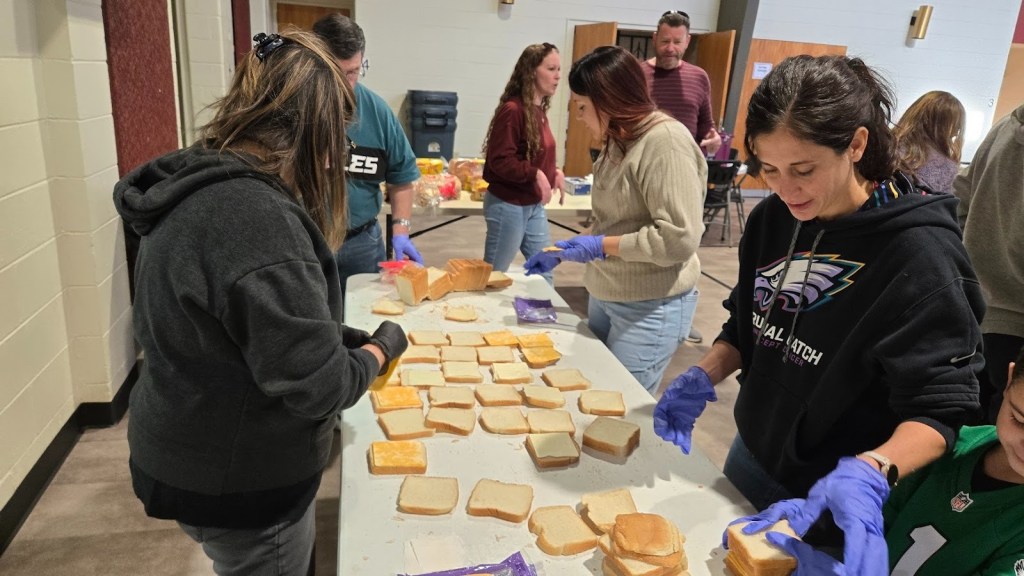
Laneader emphasized that she wasn’t alone in her efforts. On Sunday, the approximately 40 volunteers working for the Divine Deli at the Church of the Incarnation in Mantua produced 651 sandwiches, but they’ve made upwards of 1,000 on past occasions, according to Shannon Alessandrini, a stay-at-home mom from Mantua working alongside Laneader.
The remaining food goes to various other shelters with the help of Mullica Hill realtor Bob Kraemer, who covers soup kitchens and domestic violence shelters in Vineland, according to Laneader.
Besides the sandwiches, volunteers often bring their whole families, crafting place mats, decorating bags, and writing supportive notes, cards, and banners.
“People sign up to do different things… We have kind of an assembly line,” said Alessandrini.
Mantua, N.J. — Volunteers assemble sandwiches for the Divine Deli at the Church of the Incarnation’s Kernan Center in Mantua on Oct. 26, 2025. (Aidan Vanhoof)
In addition to this, once a month they personally cook an elaborate dinner for the hungry at Home of the Brave. Last time, they had former NFL player Art Still attend.
Across her now 11 years of volunteering in Camden, she’s been shot at and carjacked. But she continues, and she appears to have no intention of stopping.
“I start screaming at the top of my lungs… I turn around. And I see all the guys are on their bicycles in their wheelchairs rolling over to me. Not Ms. Marlene, not our mom,” said Laneader. “Sometimes I get up, and I’m like, ‘this year’s the last one,’ but I’m still going.”







 Aidan Vanhoof